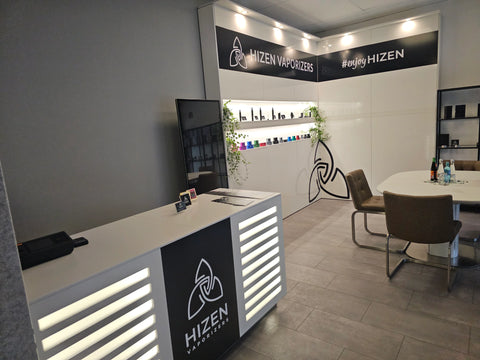
This is how it works correctly – and why temperature is everything.
GuidesReading time approx. 7 minutesFor beginners & those switching from other sports
Vaporizing cannabis means heating it until the active ingredients are released, but not so much that it burns. No fire, no embers, no smoke. Instead, vapor – at a temperature you control.
The difference to lighting a fire isn't in the material. It lies in the temperature, a few hundred degrees. And you can control that.
Short and sweet: Vaporization occurs between approximately 160 °C and 220 °C. Cannabinoids and terpenes transition into the vapor phase within this range, leaving the plant fiber behind. Combustion begins at around 230 °C – from this point on, vaporization no longer occurs.
01What does "vaporizing cannabis" mean?
A vaporizer heats dried plant material to a defined temperature. Nothing is ignited in the herb chamber. There is no ember, no ash, no open flame. What you inhale is vapor.
An ember, on the other hand, reaches well over 600°C. At that temperature, most of the material burns – including what you actually want. The vaporizer stays below this limit. That's why you taste the strain and not the combustion.
Two designs transfer heat to the material. In conduction heating , the chamber itself heats up, and the material is in direct contact with the wall. It's simple to build and heats up quickly. However, material at the edges receives more heat than material in the center. Without stirring, the result will be uneven.
In convection heating , hot air flows through the material. The chamber itself remains cooler, and the heat is distributed evenly. This is more complex to build – and the reason why a temperature reading is actually useful. Only when the heat arrives via the air does the set value correspond to what the material experiences.
02Vaporizing instead of igniting: what's changing
Four things separate the two methods. None of them are a matter of taste.
No combustion
Pyrolysis does not occur below approximately 230 °C. The following is produced: Steam instead of smoke, no ash, no embers.
Taste
Terpenes are volatile and heat-sensitive. They are preserved at low temperatures. You can taste the variety..
Efficiency
An ember continues to burn even when no one is drawing on it. A vaporizer only heats up when you turn it on.
Control
You set the temperature to within one degree Fixed. A flame cannot be regulated.
And then there's the practicality. No smell of burnt material in clothes or the room. No lighter. Nothing that lingers.
03The correct temperature for vaporizing cannabis
The most frequently asked question – and the one with the clearest answer. The ingredients don't all dissolve at once, but one after the other. Therefore, the temperature determines what you get.
160 - 175 ° C
Very mild, thin vapor, full aroma. The entry-level option – and for everyone who really wants to taste a flavor.
175 - 190 ° C
The standard range. Visible vapor, balanced aroma. This is where most sessions start.
190 - 205 ° C
Denser, warmer, more powerful. If you want to get more out of the material.
205 - 220 ° C
Hot and harsh, the aroma recedes. For the last few puffs, when there's hardly anything left.
from approx. 230 °C
Combustion. You won't evaporate here anymore. - avoid.
The practical approach: Start low, at around 175°C. Take two or three draws. Then increase in 5-degree increments. This way you work your way through the entire spectrum, instead of starting at the top. After two or three sessions, you'll know where your comfort zone lies.
The difference between 180 °C and 195 °C is only 15 degrees. However, the difference is enormous. That's precisely why a precise temperature setting is far superior to three fixed settings.
You can set the temperature to the exact degree on the display – and see where the device is currently located.
04Step by step: how to evaporate correctly
01 · Grinding
Medium-fine and uniform. Too coarse means the air flows past the pieces instead of through them. Too fine means material slips through the sieve. Grinder Clean teeth make all the difference here.
02 · Filling
Fill the chamber loosely, press down lightly – do not pack it down. Contact is important, but air must be able to pass through. A half-full chamber works less effectively than one that is evenly filled.
03 · Temperature
Start at 175 °C. Allow the appliance to heat up completely – with convection this usually takes less than a minute.
04 · Pulling
Slowly and for a long time, about 5 to 10 seconds. It's not the pulling pressure that counts, but the... Train durationThe air needs time to release heat. A short, sharp puff will only cool the chamber down.
05 · Pulling
If the steam thins, increase the temperature by 5°C instead of drawing harder. Repeat this until you reach the top.
06 · Empty
Tap out the chamber while the device is still warm – everything will come loose more easily then. Clean the screen and mouthpiece regularly with isopropanol, otherwise the airflow will be impaired.
The remaining contents in the chamber – brownish, dry, often called "ABV" – are not waste. They still contain active ingredients and are usually reused. Throwing them away is wasteful.
The grind size is crucial: only uniformly ground material allows the hot air to pass through evenly.
05What matters when choosing a dry herb vaporizer
The market is confusing. Five points separate a device you'll still be using in three years from one that ends up in a drawer.
Pure convection
Only then will the displayed temperature correspond to the actual temperature. Many inexpensive devices operate conductively and display the temperature of the heating element, not the temperature of the material itself.
Adjustable to the exact degree
Three fixed settings are not enough. The relevant range is between 160 °C and 220 °C – you want to be able to utilize that range.
Removable battery
The battery ages first. If it's permanently installed, the device will eventually reach the end of its lifespan. With a 18650 batteries for replacement You can exchange it for around ten euros.
Spare parts
Filters, mouthpieces, and seals are consumable parts. If they are not available individually, any defect results in total loss.
Materials
Glass, stainless steel, ceramic in the air duct. No plastic where the hot air flows.
HIZEN develops vaporizers in Germany – since 2014. All devices are designed for repairability: spare parts are kept in stock, and repairs are carried out in their own workshop.
The Convectum is for those who want control: pure convection, replaceable 18650 battery, precise temperature control. The Stilus Pro Max is more compact and heats up faster – built for on the go. The Nanu is the easy entry-level model. You can find all models under Vaporizers.
06Conclusion
Vaporizing cannabis isn't a question of equipment, but of temperature. Staying below the combustion threshold allows you to control the aroma, intensity, and consumption.
Three things to remember. Start at 175°C, then increase in 5-degree increments. Grind to a medium-fine consistency, fill loosely. Brew slowly and gently. The rest depends on the choice of equipment – and convection is key.
If you want to know what the legal framework is like in Germany: We've written about it in the article on Cannabis Social Clubs.
Your HIZEN Team 💚
07Frequently asked questions
What temperature is best for vaporizing cannabis?
The usable temperature range is between 160°C and 220°C. For most sessions, 175 to 190°C is the starting point: visible vapor, full flavor. Lower temperatures result in milder and more aromatic vapor, higher temperatures in denser and stronger vapor. Combustion begins at around 230°C – vaporization no longer occurs at this temperature.
What is the maximum temperature the material can withstand?
Up to around 220 °C, you'll safely remain in the vaporization range. Above that, the aroma noticeably diminishes and the vapor becomes harsh. At approximately 230 °C, pyrolysis, or combustion, begins.
How do I properly vaporize cannabis in a vaporizer?
Grind to a medium fine consistency, fill the chamber loosely and evenly, start at 175°C, allow to heat up completely, and draw slowly for 5 to 10 seconds. If the vapor becomes thinner, increase the temperature in 5-degree increments instead of drawing harder.
What is the difference between vaping and smoking?
During vaporization, the temperature remains below the combustion threshold. No embers or ash are produced, only vapor. When ignited, the temperature exceeds 600 °C, and the material burns completely. With a vaporizer, you can also set the temperature yourself.
How often do I need to clean a vaporizer?
Tap out the chamber after each session while the device is still warm. Clean the screen and mouthpiece with isopropyl alcohol approximately every 10 to 15 sessions. If the airflow decreases, it's time to do so anyway.
Can I reuse the remaining contents from the chamber?
Yes. The evaporated material, often called ABV, still contains active ingredients and is usually reused instead of being disposed of.
Do I need a grinder for a vaporizer?
Practically speaking, yes. The grind size determines how the hot air flows through the material. Unevenly ground material vaporizes unevenly. You can find suitable models in our grinder collection.
Developed in Germany · since 2014
Which vaporizer is right for you?
Pure convection, precise temperature control, replaceable battery, spare parts in stock. Take your time to look at the models – or write to us if you're unsure.
This article describes how vaporizers work and is intended for people aged 18 and over. It does not replace medical advice and makes no claims about health effects. The applicable legal regulations regarding the use of cannabis apply.
This website is intended exclusively for persons aged 18 and over.
By entering this website, you confirm that you are at least 18 years old and are allowed to use the offered content in accordance with applicable legal regulations.